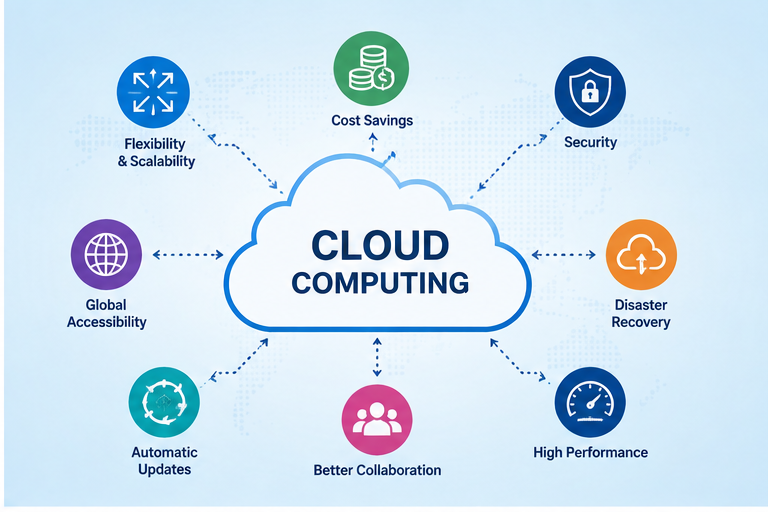
Cloud computing has become one of the most important technologies behind modern digital services. From streaming platforms and online banking to artificial intelligence and business software, cloud infrastructure helps organizations store data, run applications, and deliver services without depending entirely on physical computers located in their own offices.
However, the cloud industry is changing quickly. Businesses no longer see cloud computing simply as a place to store files or host websites. It is becoming an intelligent, distributed, automated, and highly flexible technology environment.
Understanding the latest cloud computing trends can help businesses, developers, technology professionals, and everyday users prepare for the next stage of digital transformation.
In this article, we explore 7 cloud computing trends shaping the future of technology, how they work, why they matter, and what they could mean for businesses in the coming years.
What Is Cloud Computing?
Cloud computing is the delivery of computing resources over the internet. Instead of purchasing and maintaining all hardware locally, organizations can access servers, databases, storage, networking, analytics, and software through cloud-based infrastructure.
For example, when a company stores documents online instead of keeping everything on an office computer, it is using a form of cloud technology.
Cloud services generally allow businesses to increase or decrease computing resources according to demand. This flexibility can reduce infrastructure complexity while making applications easier to scale.
Three common cloud service models are:
Infrastructure as a Service (IaaS)
IaaS provides virtual servers, storage, networking, and other computing infrastructure. Organizations can use these resources without owning the underlying physical hardware.
Platform as a Service (PaaS)
PaaS provides developers with an environment for building, testing, deploying, and managing applications without having to manage every part of the underlying infrastructure.
Software as a Service (SaaS)
SaaS delivers complete applications through the internet. Email platforms, online productivity applications, customer relationship management systems, and collaboration tools are common examples.
As these models continue to evolve, several new trends are changing how cloud technology is designed and used.
1. Artificial Intelligence and Cloud Computing Are Becoming Closely Connected
Artificial intelligence is one of the biggest forces influencing the future of cloud computing.
Modern AI applications can require significant processing power, specialized hardware, large datasets, and scalable storage. Building all of this infrastructure locally can be expensive and complicated.
Cloud environments can make these resources more accessible.
Businesses can use cloud-based AI services for tasks such as:
- Customer service automation
- Data analysis
- Fraud detection
- Recommendation systems
- Image recognition
- Predictive maintenance
- Generative AI applications
This combination is particularly important for smaller organizations. A company does not necessarily need to build its own advanced AI infrastructure before experimenting with intelligent applications.
Generative AI Will Increase Cloud Demand
Generative AI systems can create text, images, software code, audio, and other digital content. Training and operating sophisticated AI models may require substantial computing resources.
As generative AI adoption grows, demand for cloud-based computing capacity and AI infrastructure is likely to remain an important technology trend.
Cloud platforms are therefore evolving from basic infrastructure providers into environments where organizations can develop and operate increasingly intelligent applications.
2. Hybrid Cloud and Multi-Cloud Strategies Are Growing
Businesses do not always want to depend on a single cloud environment.
This has contributed to the growth of hybrid cloud and multi-cloud strategies.
A hybrid cloud combines private infrastructure with public cloud services. An organization might keep particularly sensitive information within a controlled environment while using public cloud resources for applications that need greater scalability.
A multi-cloud strategy involves using services from more than one cloud provider.
For example, a business could use one platform for data storage, another for analytics, and a different service for specialized workloads.
Why Are Businesses Using Multiple Cloud Environments?
There are several potential reasons:
- Greater flexibility
- Access to specialized services
- Improved resilience
- Regulatory or data-management requirements
- Reduced dependence on one provider
- Better workload optimization
However, managing multiple environments can also increase complexity. Organizations need effective monitoring, security policies, governance, and skilled professionals to keep everything operating efficiently.
3. Edge Computing Is Bringing Processing Closer to Users
Traditional cloud computing often sends information to centralized data centers for processing.
For many applications, this approach works extremely well. But certain technologies require extremely fast responses.
This is where edge computing becomes important.
Edge computing processes information closer to the device, user, or location where that information is generated.
Consider an intelligent manufacturing facility containing hundreds of sensors. Sending every piece of sensor information to a distant cloud server before making a decision could introduce unnecessary delays.
Edge systems can process urgent information locally while sending other data to the cloud for storage and deeper analysis.
Where Is Edge Computing Useful?
Potential applications include:
- Autonomous and connected vehicles
- Smart factories
- Internet of Things devices
- Healthcare technology
- Smart cities
- Retail systems
- Telecommunications
- Real-time monitoring
Edge computing does not necessarily replace cloud computing. Instead, the two technologies can work together.
The cloud provides large-scale storage and processing, while edge systems handle workloads that benefit from lower latency and faster local decisions.
4. Serverless Computing Is Simplifying Application Development
Despite its name, serverless computing still relies on servers.
The difference is that developers do not have to manage much of the underlying server infrastructure directly.
With serverless architecture, developers can focus more heavily on application code while the cloud environment handles tasks such as infrastructure provisioning and scaling.
This can make certain applications faster and easier to develop.
Benefits of Serverless Computing
Serverless architectures can provide several advantages:
Automatic scaling: Resources can expand or decrease depending on application demand.
Reduced infrastructure management: Development teams can spend less time managing servers.
Usage-based costs: Depending on the service and workload, organizations may pay primarily for the resources their applications actually consume.
Faster development: Developers can concentrate more on application functionality.
Serverless technology is particularly useful for APIs, automation tasks, event-driven applications, backend services, and workloads with changing levels of demand.
It is not ideal for every application, but its flexibility makes it an important part of modern cloud development.
5. Cloud Security Is Becoming More Advanced
As organizations move important applications and information into cloud environments, cybersecurity becomes increasingly important.
Cloud platforms can provide sophisticated security technologies, but organizations still need to configure and manage their environments carefully.
Modern cloud security increasingly uses automation, artificial intelligence, identity management, encryption, continuous monitoring, and zero-trust principles.
The Rise of Zero-Trust Security
Traditional security models often focused heavily on protecting the network perimeter.
Zero-trust architecture follows a different principle: users, devices, and applications should be appropriately verified rather than automatically trusted simply because they are already inside a network.
Organizations may use techniques such as:
- Multi-factor authentication
- Identity and access management
- Data encryption
- Continuous security monitoring
- Role-based permissions
- Automated threat detection
- Security logging
Human error and incorrect configuration remain important challenges. Therefore, cloud security is not simply about purchasing security tools. Organizations also need strong policies, employee education, monitoring, and regular security reviews.
6. Sustainable and Green Cloud Computing Is Gaining Importance
Data centers require substantial amounts of electricity to operate servers, networking equipment, storage systems, and cooling infrastructure.
As digital services expand, the environmental impact of computing has received greater attention.
This is contributing to another major trend: green cloud computing.
Cloud providers and data-center operators are working to improve energy efficiency and, in many cases, increase the use of lower-carbon and renewable energy sources.
How Can Cloud Computing Become More Sustainable?
Strategies may include:
- Improving data-center cooling
- Increasing server utilization
- Using more energy-efficient hardware
- Reducing unnecessary computing workloads
- Using renewable energy
- Optimizing software efficiency
- Extending hardware life where practical
Organizations can also improve efficiency by monitoring unused cloud resources.
For example, a company might continue paying for virtual machines or storage capacity that is no longer required. Identifying and removing unnecessary resources can potentially reduce both costs and energy consumption.
Sustainability is therefore becoming connected to cloud optimization rather than being treated as a completely separate objective.
7. Cloud Automation and AIOps Are Expanding
Modern cloud environments can contain thousands of resources, services, applications, databases, and security configurations.
Managing this complexity manually can become difficult.
Automation is increasingly being used to handle repetitive cloud-management tasks.
Organizations can automate activities such as deployment, resource scaling, backups, monitoring, security checks, and infrastructure configuration.
Another important development is AIOps, or artificial intelligence for IT operations.
AIOps combines technologies such as machine learning, automation, and data analytics to help IT teams understand and manage complex technology environments.
For example, an AIOps platform may analyze system activity and identify unusual behavior before it develops into a larger operational problem.
Why Cloud Automation Matters
Automation can help organizations achieve:
- Faster deployments
- More consistent configurations
- Reduced manual work
- Better resource utilization
- Faster incident detection
- Improved scalability
As cloud infrastructure becomes increasingly complicated, intelligent automation is likely to become an essential management tool rather than an optional feature.
How These Cloud Computing Trends Work Together
The most interesting development is not any single trend. It is how these technologies interact.
Imagine a modern manufacturing company.
IoT sensors installed throughout a factory continuously generate operational data. Edge computing processes urgent information near the machines. Other data is transferred to cloud infrastructure for long-term storage.
Artificial intelligence analyzes the information and identifies patterns that could indicate equipment problems.
Automation can then alert engineers or trigger predefined actions.
Meanwhile, zero-trust security policies control access to sensitive systems, while a hybrid cloud architecture allows the company to decide which workloads remain private and which operate in public cloud environments.
This example demonstrates how cloud computing is becoming the foundation connecting many different digital technologies.
Major Benefits of Modern Cloud Computing
The continuing development of cloud technology provides several potential benefits for organizations.
Scalability
Businesses can adjust computing resources as demand changes rather than permanently maintaining maximum infrastructure capacity.
Flexibility
Employees and applications can access cloud resources from different locations when appropriate access controls are in place.
Faster Innovation
Developers can experiment with databases, AI tools, analytics platforms, and infrastructure without always building systems from scratch.
Business Continuity
Cloud-based backups and distributed infrastructure can support disaster recovery and operational resilience when configured correctly.
Access to Advanced Technology
Smaller companies can access sophisticated computing technologies that might otherwise require major infrastructure investment.
Challenges Facing the Future of Cloud Computing
Cloud technology offers significant opportunities, but it also creates challenges.
Security remains one of the most important concerns. Poorly configured services, weak passwords, excessive permissions, and compromised accounts can expose sensitive information.
Costs can also become difficult to control. Cloud services may appear inexpensive individually, but large numbers of unused or poorly optimized resources can increase expenses.
Another challenge is technical complexity. Hybrid cloud, multi-cloud, AI infrastructure, containers, edge systems, and automated deployments require specialized knowledge.
Organizations should therefore develop a clear cloud strategy instead of adopting new technology simply because it is popular.
Best Practices for Businesses Adopting Cloud Technology
Organizations planning to increase their use of cloud computing should focus on long-term management as well as initial deployment.
Important practices include regularly reviewing cloud costs, applying strong access controls, encrypting sensitive information, maintaining backups, monitoring workloads, training employees, and automating repetitive processes where appropriate.
Businesses should also avoid unnecessary complexity. Using several cloud platforms can provide flexibility, but every additional platform may require new security policies, skills, monitoring systems, and management processes.
Technology decisions should ultimately support genuine business requirements.
The Future of Cloud Computing
Cloud computing is gradually becoming less visible to end users while becoming more important behind the scenes.
People may simply interact with an intelligent application without thinking about whether its AI model is operating in a cloud data center, at the edge, or through a combination of both.
Future cloud platforms are likely to become increasingly automated, distributed, intelligent, secure, and energy-conscious.
AI workloads will continue influencing infrastructure design. Edge computing will support applications that require faster responses. Hybrid and multi-cloud strategies will provide organizations with more architectural choices.
At the same time, security, cost management, privacy, regulatory requirements, and sustainability will remain important considerations.
The organizations that benefit most from these developments will likely be those that treat cloud computing as a strategic technology platform rather than simply online storage.
Frequently Asked Questions
What are the biggest cloud computing trends?
Major cloud computing trends include artificial intelligence integration, hybrid and multi-cloud environments, edge computing, serverless architecture, advanced cloud security, sustainable data centers, and intelligent cloud automation.
Will AI increase the use of cloud computing?
AI can significantly increase demand for scalable computing, specialized processors, storage, and data-management services. Cloud infrastructure provides organizations with flexible access to many of these resources.
What is the difference between cloud and edge computing?
Cloud computing generally processes and stores information using remote computing infrastructure. Edge computing moves certain processing tasks closer to the devices or locations generating the data.
Is cloud computing secure?
Cloud environments can provide strong security capabilities, but security also depends on how organizations configure and manage them. Access controls, encryption, monitoring, authentication, updates, and employee awareness are all important.
Will cloud computing continue growing?
Cloud computing is expected to remain a major foundation for digital transformation because technologies such as AI, IoT, analytics, automation, and modern applications increasingly rely on scalable computing infrastructure.

Conclusion
The 7 cloud computing trends shaping the future of technology demonstrate how quickly the cloud industry is evolving.
Artificial intelligence is making cloud platforms smarter. Hybrid and multi-cloud strategies are increasing flexibility. Edge computing is bringing processing closer to users and devices. Serverless computing is simplifying certain development workflows, while advanced security technologies are helping organizations protect increasingly complex environments.
At the same time, sustainable cloud infrastructure and intelligent automation are changing how computing resources are operated and managed.
Cloud computing is no longer simply an alternative to traditional servers. It has become an important foundation for AI, connected devices, modern applications, digital businesses, and emerging technologies.
Businesses that understand these trends and adopt cloud technology strategically will be better prepared to compete and innovate as the digital world continues to evolve.