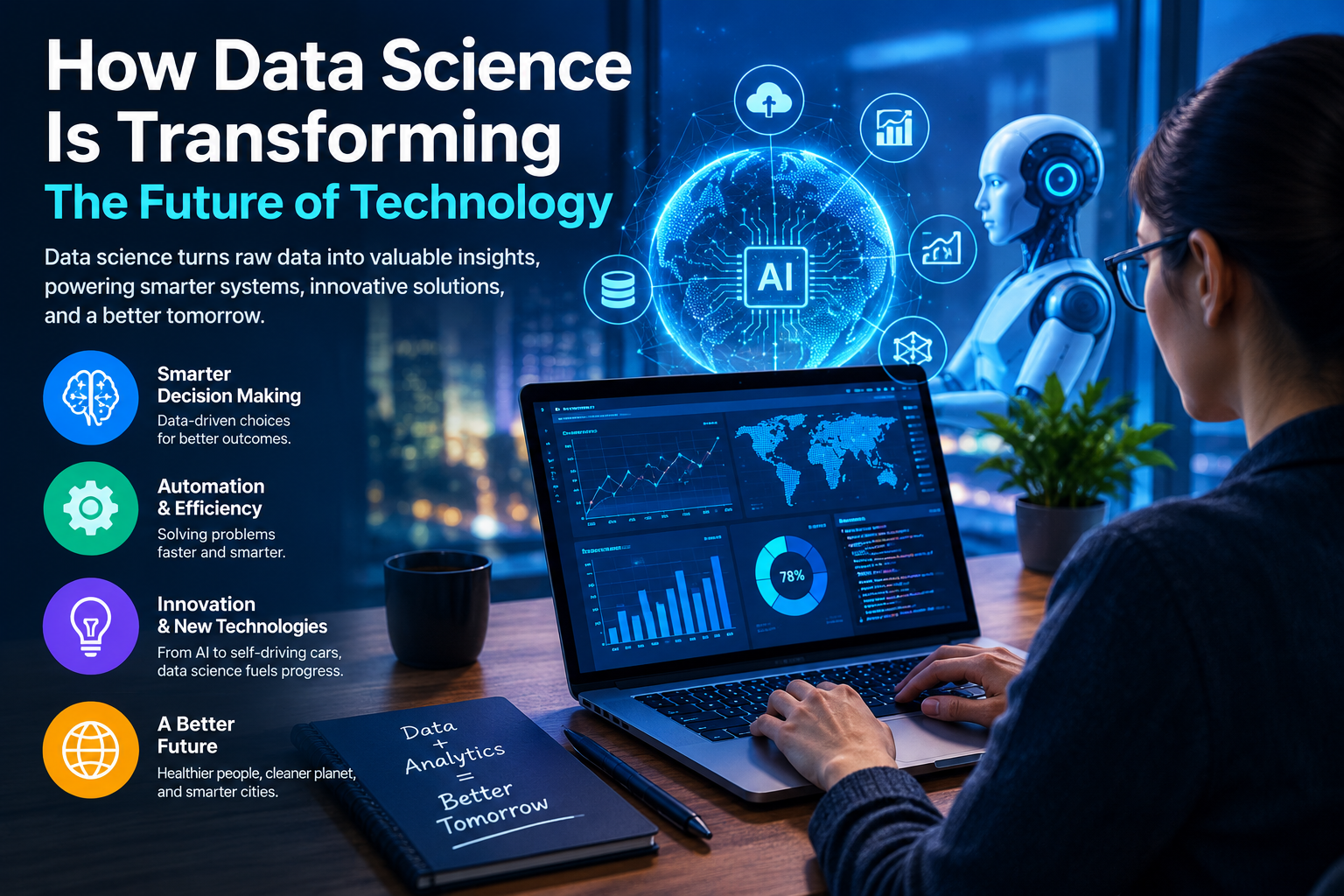
Technology is evolving faster than ever, and data science is one of the major forces driving this transformation. Every day, businesses, websites, smartphones, healthcare systems, financial institutions, and digital platforms generate enormous amounts of data. However, raw data alone has limited value. The real opportunity lies in understanding that data and turning it into useful information.
This is where data science plays an important role. By combining statistics, programming, artificial intelligence, machine learning, and analytical techniques, data science helps organizations discover patterns, predict outcomes, and make smarter decisions.
From personalized online experiences to intelligent healthcare systems and automated business processes, data science is transforming the future of technology in ways that affect both businesses and everyday life.
What Is Data Science?
Data science is the process of collecting, organizing, analyzing, and interpreting data to generate meaningful insights. It combines several disciplines, including mathematics, statistics, computer science, machine learning, and data visualization.
A data scientist may work with structured information, such as customer records and sales figures, as well as unstructured information, including images, videos, social media posts, and written documents.
The goal is not simply to collect more information. Instead, data science focuses on finding useful patterns that can help organizations solve problems, understand behavior, improve services, and prepare for future changes.
The Connection Between Data Science and Artificial Intelligence
One of the most significant ways data science is shaping modern technology is through artificial intelligence (AI).
AI systems require large amounts of quality data to learn how to recognize patterns and make decisions. Data science provides many of the methods required to prepare, analyze, and manage this information.
For example, AI-powered systems can analyze customer behavior to provide personalized recommendations. Similar technologies are used in virtual assistants, fraud detection systems, image recognition tools, and automated customer support.
As AI becomes more advanced, reliable data and effective data analysis will remain essential to its development.
Machine Learning Is Becoming More Powerful
Machine learning is another technology closely connected with data science. Instead of programming a computer with a fixed response for every possible situation, machine learning allows systems to learn patterns from existing data.
Consider an online shopping platform. By studying previous purchases, searches, browsing behavior, and product interactions, machine learning models can estimate which products a customer may find useful.
These systems can improve as they receive additional relevant data.
Machine learning is now being applied across industries such as finance, education, manufacturing, transportation, cybersecurity, and healthcare. As computing capabilities continue to develop, its applications are likely to become even broader.
Data Science Is Improving Business Decision-Making
Traditional business decisions were often based heavily on experience, assumptions, and historical reports. Data science gives organizations an opportunity to support those decisions with measurable evidence.
Companies can analyze sales trends, customer behavior, marketing performance, operational costs, and market changes. This information can help decision-makers understand what is working and where improvements may be required.
For example, a retailer can analyze purchasing patterns to determine which products are in demand. A digital business can examine website data to understand which pages attract visitors and where users leave.
This approach is often described as data-driven decision-making, and it is becoming increasingly important in competitive markets.
Transforming the Healthcare Industry
Healthcare is one of the areas where data science has significant potential.
Healthcare organizations generate large amounts of information through medical records, laboratory results, imaging systems, wearable devices, and clinical research. When handled responsibly, data analysis can help professionals identify useful trends and improve healthcare processes.
Data science can support areas such as disease research, hospital resource planning, medical imaging analysis, and the development of personalized treatment approaches.
Wearable technology is another example. Smart devices can collect information such as activity levels, sleep patterns, and heart rate. Data analysis can then transform these measurements into information users and professionals may find useful.
However, healthcare data is highly sensitive, making privacy, security, accuracy, and appropriate human oversight especially important.
Strengthening Cybersecurity
As technology becomes more connected, cybersecurity threats continue to evolve. Data science can help security teams analyze large volumes of digital activity and identify unusual patterns.
For example, an organization may use analytical systems to detect unexpected login behavior, suspicious transactions, or unusual network activity.
Machine learning models can also help security tools identify patterns associated with potential threats. This does not eliminate the need for cybersecurity professionals, but it can help them process information more efficiently and prioritize potential risks.
As cyber threats become increasingly sophisticated, combining human expertise with data-driven security tools will remain important.
Creating More Personalized Digital Experiences
Personalization has become a common feature of modern technology.
Streaming services can recommend content based on viewing behavior. E-commerce platforms can suggest relevant products, while digital applications can adapt content based on user preferences.
Many of these experiences are powered by data science.
By analyzing how people interact with digital services, organizations can identify patterns and create more relevant experiences. Effective personalization can make services easier to use and help users discover information or products that match their interests.
At the same time, responsible companies must balance personalization with transparency, privacy, and appropriate data protection.
Data Science and the Future of Smart Technology
Smart technologies generate continuous streams of information. Connected devices, sensors, industrial equipment, vehicles, and smart infrastructure can all produce valuable data.
Data science helps transform this information into practical insights.
For example, sensors in manufacturing equipment can provide data that may help businesses identify signs of equipment problems. Transportation systems can analyze traffic patterns to improve planning, while smart energy systems can use consumption data to improve efficiency.
The combination of the Internet of Things (IoT), artificial intelligence, and data science is likely to support the development of increasingly connected environments.
Automation and the Changing Workplace
Data science is also contributing to workplace automation.
Businesses can use intelligent systems to analyze documents, categorize information, forecast demand, detect patterns, and automate repetitive processes. This can allow employees to spend more time on tasks requiring creativity, communication, judgment, and strategic thinking.
Automation will also change the skills demanded in many industries. Knowledge of data analysis, AI tools, digital systems, and data literacy is becoming useful across a growing range of careers.
Rather than viewing data science only as a technical profession, it is increasingly helpful to see it as a capability influencing many different jobs.
Challenges of a Data-Driven Future
Despite its advantages, data science also introduces important challenges.
Privacy is one of the biggest concerns. Organizations must be careful about how personal information is collected, stored, processed, and shared.
Another challenge is data quality. An advanced algorithm cannot automatically compensate for inaccurate, incomplete, outdated, or poorly collected information.
Bias is equally important. If datasets contain historical or sampling biases, automated systems may reproduce or amplify them. For this reason, responsible data science requires careful testing, transparency, security measures, and human oversight.
Organizations must focus not only on what technology can do but also on how it should be used.
The Future of Data Science and Technology
The influence of data science is expected to expand as organizations generate more information and adopt more advanced digital technologies.
Artificial intelligence, predictive analytics, cloud computing, automation, robotics, IoT, and cybersecurity will increasingly depend on effective data management and analysis.
At the same time, data science tools are becoming more accessible. Modern platforms can automate parts of data preparation, visualization, and model development, allowing more professionals to work with data without being specialized data scientists.
The future will therefore involve both advanced technical specialists and everyday professionals who understand how to interpret and responsibly use data.
Conclusion
Data science is transforming the future of technology by turning enormous amounts of information into meaningful insights. It is supporting artificial intelligence, strengthening cybersecurity, improving business decisions, enabling personalization, advancing healthcare technology, and contributing to smarter automated systems.
Its importance will continue to grow as the digital world produces more data. However, successful adoption requires more than powerful algorithms. Organizations also need reliable data, strong security, ethical practices, transparency, and human judgment.
Data science is not simply about numbers. It is about using information intelligently to solve problems, improve technology, and create better digital experiences.